
Olive Oil Press: What It Is and What It Is Used For
The olive oil press is part of the history of the olive grove, the oil mills, and a gastronomic culture that has evolved over centuries. Although today many oil mills work with modern centrifugation systems, the term “pressing” is still very present when we talk about extra virgin olive oil, first cold press, or traditional extraction.
Understanding what a press is, how it works, and what role it plays in the production of oil helps to better appreciate each bottle of EVOO. It also allows us to distinguish between real concepts, commercial expressions, and production methods that influence the flavor, aroma, and preservation of the oil.
What is an olive oil press?
An olive oil press is a machine designed to apply pressure to the paste obtained after grinding the olives. Its goal is to separate the liquid part, composed of oil and vegetable water, from the solid part formed by skin, pulp, and pit.
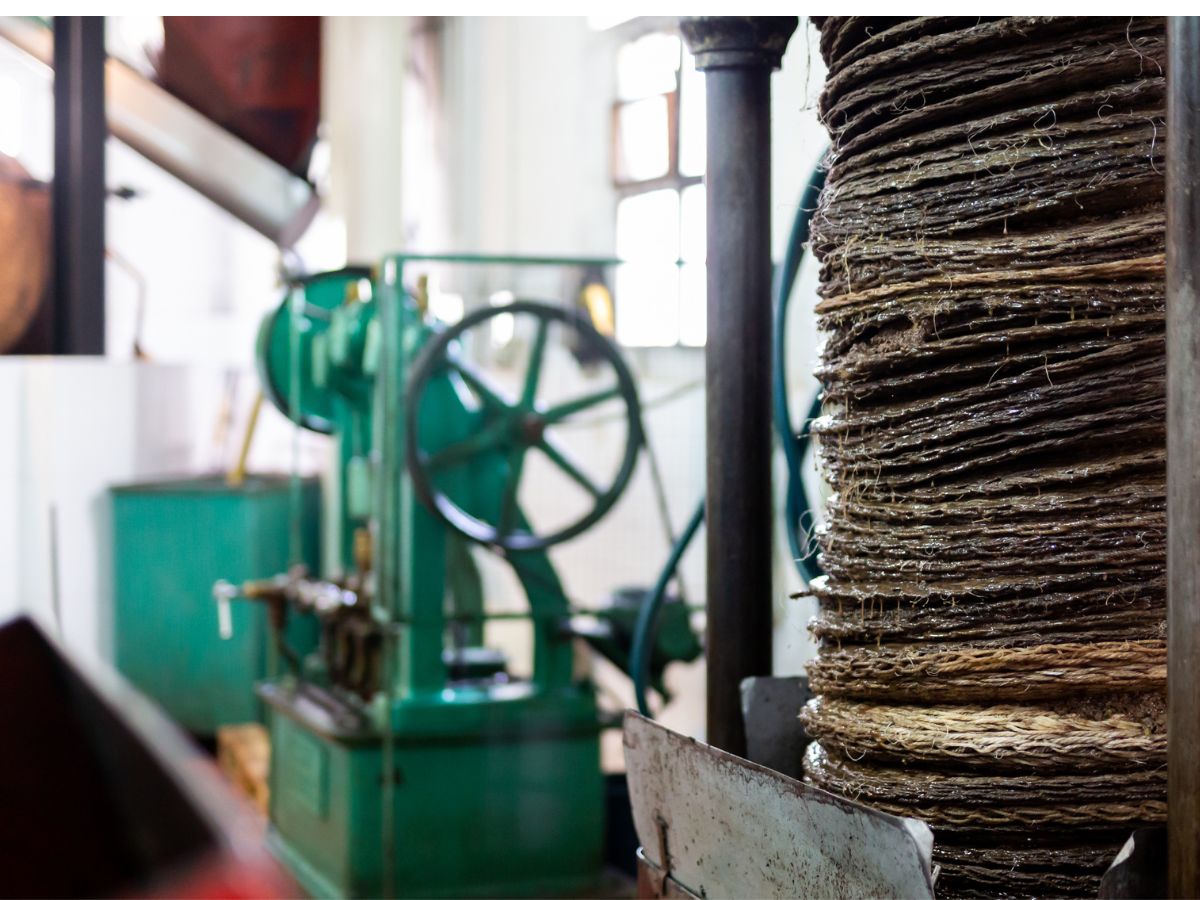
In traditional systems, the olive was crushed until a mass was formed. Then, that paste was placed on mats, discs made of vegetable fiber or filtering material, which were stacked and subjected to pressure. By compressing them, an oily liquid would come out that later had to be separated by decantation.
In simple terms, the press acts as an extraction mechanism. It doesn’t “create” the oil, because the oil is already inside the fruit. What it does is make it easier for the oil to come out of the olive after breaking its cells during milling.
Today, when we talk about quality extra virgin olive oil, it is important to clarify something: the majority of current EVOOs are not obtained with traditional hydraulic presses, but through continuous centrifugation systems. Even so, the press still has historical, technical, and cultural value, especially in oleotourism and in explaining the old production process.
What an oil press is used for
An oil press is used to extract the oil contained in the olive paste by mechanical pressure. Its main function is to separate the liquid phase from the solid mass.
But its usefulness goes beyond the simple physical process. The press allows us to understand how traditional oil production began and why oil mills have been key spaces in Mediterranean culture.
In the context of oleotourism, seeing an old press helps to understand the evolution of the sector. Previously, the yield depended on the force applied, the type of mat, the state of the olive, and the decantation time. Today, technology allows us to work with more precision, better control the temperature, and reduce the oil’s contact with oxygen.
That’s why the press has a double meaning: it is an extraction tool and also a symbol of the history of olive oil.
Steps for the extraction process:
The extraction of olive oil begins long before the press or the centrifuge. The quality is decided from the olive tree: variety, sanitary state of the fruit, harvesting time, transport, and speed of milling.
A healthy olive, picked at the right point and milled within a few hours has a better chance of producing a balanced, aromatic, and stable oil. Afterwards, in the mill, several phases are involved.
Milling
Milling consists of crushing the olive to form a homogeneous paste. In this phase, the skin, the pulp, and part of the pit are broken. When the fruit's cells are broken, the small drops of oil begin to be released.
Traditionally, stone mills were used. They were slow, but they were part of a process closely linked to the rhythm of each mill. Today, many facilities use metal mills, such as hammer, disc, or blade mills, which allow faster and more controlled milling.
Milling influences the final result. Proper crushing favors extraction, but aggressive treatment can affect certain aromatic nuances. That is why, in high-quality extra virgin olive oils, balance is sought: to extract well, but without damaging the paste.
Milling is the first critical point in the mill, because it transforms the olive into a mass prepared to release its oil.
Malaxation
Malaxation is the phase in which the olive paste is slowly stirred. This movement facilitates the small oil droplets to join together and form larger drops, which are easier to separate afterwards.
During malaxation, temperature control is essential. Working at low temperatures helps better preserve the aromas, phenolic compounds, and freshness of the oil. On the other hand, high temperatures can increase yield, but harm sensory quality.
Here a key concept appears: it's not all about extracting more oil, but about obtaining better oil. In premium EVOOs, the goal is not to squeeze the olive to the maximum, but to protect its qualities.
The malaxation time also matters. Too short a malaxation can make extraction difficult. Too long can increase oxidation and reduce aromatic liveliness. That is why each olive variety requires specific adjustments.
Pressing
Pressing is the traditional phase in which the malaxed paste is subjected to pressure. The mass is distributed in mats and compressed to extract the liquid. That liquid contains oil, vegetation water, and small solid particles.
Afterwards, the oil must be separated from the rest. In the past, this was done by natural decantation, letting the liquid settle so the phases would separate by density difference. This method required time and a lot of cleanliness, because any vegetable residue could ferment and generate defects.
In modern production, traditional pressing has been almost completely replaced by centrifugation. Even so, the word “pressing” is still alive in popular language. Many people say “pressed oil” to refer to oil obtained by mechanical means, even though technically it may have been extracted by centrifugation.
The key is not only whether it is pressed or centrifuged, but how the olive is treated throughout the entire process.
Types of oil presses
There are different systems for extracting olive oil. Some belong to the olive oil tradition and others are a result of the technological evolution of today’s oil mills.
Traditional presses
Traditional presses can be beam, screw, or hydraulic. The best-known in recent production are hydraulic presses, which have been used for decades in many oil mills.
In this system, the olive paste is placed in stacked mats. The press applies pressure and the liquid comes out slowly. It is a visual, artisanal process closely linked to the classic image of the oil mill.
Their advantages are clear from a historical and cultural point of view. They allow us to explain the origin of oil, show the old work, and connect with olive oil tourism. However, they have technical limitations compared to current systems.
The mats require very thorough cleaning. If not cleaned well, they can retain paste residues and cause fermentations. In addition, the process is usually slower and less efficient.
For this reason, although some oil mills keep presses for tradition or for specific productions, the dominant model in today’s EVOO is the continuous centrifugation system.
Modern systems (centrifugation)
Centrifugation separates the oil from the paste by centrifugal force. Instead of applying pressure to mats, the mass enters equipment that spins at high speed and separates the phases according to their density.
In a modern oil mill, the process usually includes a horizontal centrifuge, also called a decanter, and in many cases a vertical centrifuge to clean the oil from small impurities or traces of moisture.
This system allows for more hygienic work, greater speed, and better technical control. It also reduces prolonged contact with vegetable residues, which is important for maintaining oil stability.
In high-end extra virgin olive oils, technology is aimed at protecting the sensory profile: fruitiness, bitterness, pungency, green aromas, notes of grass, tomato, almond, artichoke, or banana, depending on the variety and harvest time.
Centrifugation does not detract from the authenticity of the oil. On the contrary: when well used, it helps obtain clean, expressive, and stable EVOOs.
What is first cold pressing?
The first cold pressing is a traditional expression that refers to oil obtained through a first mechanical pressing of the olive paste at a low temperature. Under European regulations, this mention is reserved for virgin or extra virgin oils obtained at less than 27 ºC using traditional hydraulic press systems.
This means that not all modern oil can be correctly called “first cold pressing.” If the oil is obtained through centrifugation, the proper technical expression is “cold extraction,” as long as the process is carried out below 27 ºC.
The difference may seem small, but it is not. “First cold pressing” refers to traditional pressing; “cold extraction” refers to modern systems such as centrifugation.
In both cases, the most important concept is temperature. Working cold helps to better preserve the aromas and certain natural compounds in the oil. That is why many quality EVOOs highlight this information in their communication.
Now, it is worth avoiding a common mistake: thinking that “first cold pressing” always means better oil. The final quality depends on many factors: healthy olives, early or optimally timed harvest, rapid milling, cleanliness, oxygen control, storage, and filtering.
Does the pressing method affect the quality of olive oil?
Yes, the extraction method affects the quality of olive oil, but it does not act alone. A traditional press can produce good oil if the olives are excellent and the process is carefully managed. Likewise, a modern mill can produce high-quality EVOO if each phase is well controlled.
The problem arises when everything is reduced to a marketing phrase. An oil is not better just because it says “pressed” or “cold.” What matters is to analyze the whole picture.
The factors that most influence quality are:
-
Sanitary condition of the olive.
-
Time between harvesting and milling.
-
Grinding and malaxation temperature.
-
Cleanliness of the machinery.
-
Exposure time to oxygen.
-
Proper separation of water and solids.
-
Filtering and preservation.
-
Storage protected from light, air, and heat.
In health and nutrition, the interest in EVOO is linked to its fat profile, its natural antioxidants, and its phenolic compounds. These elements are better protected when the process avoids high temperatures, oxidation, and poor preservation practices.
Therefore, when choosing a good extra virgin olive oil, it is advisable to look beyond the word “press.” It is better to pay attention to the category, the harvest, the variety, the origin, the extraction type, the best-before date, and the packaging.
At Olivarte, talking about olive oil press means talking about tradition, but also about culture and knowledge. The press connects us to the roots of the olive grove; current technology allows us to enjoy EVOOs that are more precise, clean, and expressive.
The best oil is not the one that boasts an old term, but the one that respects the olive from the tree to the bottle.

Leave a comment
This site is protected by hCaptcha and the hCaptcha Privacy Policy and Terms of Service apply.